THE ECONOMICS OF THE 2026 NBA FINALS
The Knicks lead the Spurs 3–1, but the financial outcomes were largely decided before Game 1. A ledger of who wins, who loses, and who just gets the bill.
By Liyam Flexer · Published Jun 12, 2026 · 8 min read
On This Page
The 2026 NBA Finals — the Knicks up 3–1 on the Spurs as of publication, a rematch of 1999 — will crown a champion within the week. The financial outcome needs no Game 5: almost every dollar that matters was allocated before the opening tip, and the trophy will reallocate surprisingly little of it.
That is the most useful lens for reading the blizzard of numbers around this series. Follow each constituency's ledger — city, franchise, player, fan, sponsor — and ask what actually changes if New York closes it out versus San Antonio forcing Game 7 on June 19.
The city ledger: real spending, inflated multipliers
The headline claims are enormous. St. Mary's University economist Steve Nivin estimated the Spurs' Finals run could generate up to $440.6 million for San Antonio's economy — comparable to the 2025 NCAA Final Four — with a seven-game series worth $350–400 million. In New York, the Economic Development Corporation put the Knicks' playoff run at $202 million in economic activity, a figure the mayor's office promoted enthusiastically.
Treat both numbers as ceilings, not measurements. The academic literature on mega-events is blunt about why: most of the money counted in impact studies is substitution, not addition. A New Yorker who spends $400 on a sports bar, a jersey, and a ride home was going to spend most of that $400 in the city anyway — at a restaurant, a theater, a different bar. The spending shifts between local businesses; it does not appear from nowhere. The portion that genuinely enters the local economy comes from visitors, and by the NYC EDC's own accounting only about 30% of Finals tickets were bought by out-of-towners.
San Antonio's case is structurally stronger than New York's, which is the more interesting point. A Finals game is a smaller share of New York's $1-trillion-plus economy than a rounding error; in San Antonio, a deep Spurs run is one of the largest events the city hosts, hotel capacity binds, and a higher share of arena spending comes from outside the metro. Small markets capture mega-event spillovers that giant markets barely notice — the inverse of how the franchises themselves rank.
The franchise ledger: the title is not the asset
Here is the number that should reframe the whole series: the Knicks have not won a championship since 1973, and they are still the third-most-valuable franchise in basketball — $10.1 billion by CNBC's 2026 count, $9.9 billion averaged across CNBC, Forbes, and Sportico. The Spurs, with five titles, average $4.4 billion. The Warriors top the league at $11 billion.
Championships do not drive franchise value. Scarcity and market do. There are 30 NBA franchises, they almost never come up for sale, and league-wide team values have appreciated roughly 2,568% over 28 years. That is an economic moat made of artificial supply restriction — owning the Knicks is owning the only major-league basketball asset in the largest media market in America, title or no title. The Finals appearance adds playoff gate revenue (and, as we'll see, that margin is fat), but the asset was already priced.
The franchise that gains the most durable value from this series is arguably the one trailing 3–1. Victor Wembanyama reaching the Finals at 22 converts San Antonio from a small-market team with a generational prospect into a contender with a face — the kind of narrative shift that compounds across a decade of ticket pricing, sponsorship renewals, and a $302 million extension decision that suddenly looks like the cheapest asset in sports. Losing the Finals with Wembanyama is a better balance-sheet event than most franchises' championships.
The player ledger: the pool is a rounding error
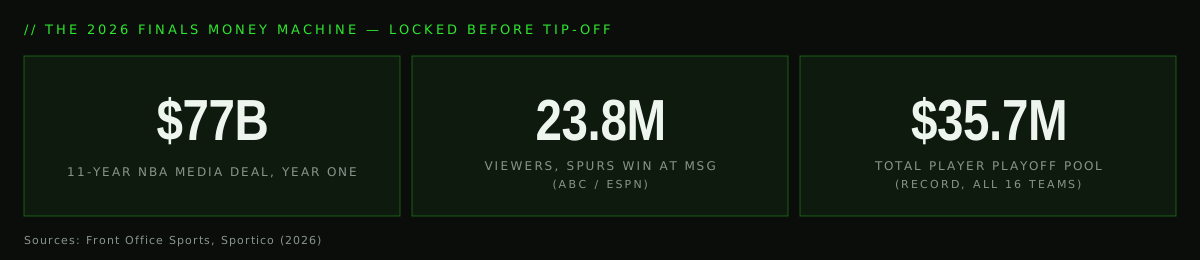
The 2026 playoff pool is a record $35.7 million, distributed across all 16 playoff teams by regular-season seeding and playoff advancement, and paid out weeks after the Finals end. A champion's share lands around $740,000–$850,000 per player depending on seed.
Against NBA payrolls, that is decorative. Leaguewide salaries run in the billions; the entire pool is well under 1% of them, and a max player earns a championship share's worth of salary in roughly a week. The real player economics of a Finals run are off the court: the leverage a title run adds to the next contract, and the endorsement repricing for a breakout star. Which is why the most consequential "player outcome" of this series is not the pool split — it is what a Finals MVP-caliber June does to the price of everything Wembanyama signs next.
There is one genuinely collective effect, and sports economist Victor Matheson of the College of the Holy Cross identified it precisely: record gate revenue flows into Basketball Related Income, which sets the salary cap, which lifts contracts for "every player from the best to the worst in the NBA. It trickles down to everyone." The Finals windfall is socialized across the league's labor force.
The fan and sponsor ledger: who captures the surplus
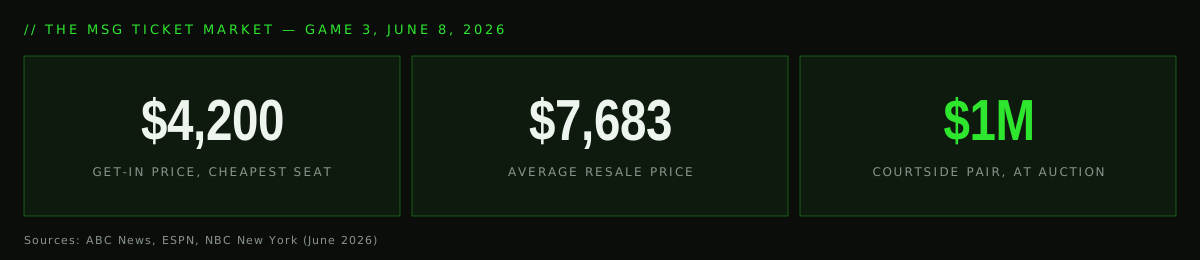
The fan side of this Finals is a price-discovery experiment with no historical comparable. Get-in prices for Game 3 at Madison Square Garden hovered around $4,200, the average resale ticket sold for $7,683, courtside ran $43,000–$75,000, premium seats pushed past $40,000, and one courtside pair sold at auction for $1 million. A potential Game 6 at MSG on June 16 was trending toward a $5,300 floor.
Two findings from the economists studying this market are worth keeping. Matheson: "The costs as a percentage of sales fall to basically nothing when ticket prices go up this much. It's a good chunk of change for the teams" — at these prices, a Finals gate is nearly pure margin. And Temple's Michael Leeds notes that the highest-priced sales happened on resale platforms, meaning a meaningful slice of fan spending never reaches the team, the city, or the league at all — it accrues to ticketing intermediaries as fees. The fan pays experience-economy prices — live scarcity is exactly the asset class we described in the end of the stuff economy — and the surplus is split between the franchise and the platforms.
For sponsors and broadcasters, the series is already a win regardless of outcome. This is year one of the league's 11-year, $77 billion media agreement with NBC/Peacock, Amazon, and ESPN/ABC — signed before a single 2026 Finals ad was sold. The season averaged 1.78 million viewers per national game, up 16% and the best in seven years; the playoffs through the conference semifinals drew 4.5 million per game, the best in 29 years; and the Spurs' lone win at MSG averaged 23.8 million viewers. A Knicks–Spurs Finals — largest market versus the sport's most marketable young star — is the inventory advertisers thought they were buying when those deals were priced. The audience is the network effect; the rights deal is the toll booth.
So who actually wins and loses?
| Constituency | If the Knicks close it out | If the Spurs come back | What the trophy changes |
|---|---|---|---|
| NBA / broadcasters | Record big-market ratings | Two more games of inventory, Wembanyama narrative | Almost nothing — the $77B is signed |
| New York City | Parade costs plus a modest visitor bump | Bars keep two more watch nights | Little — $202M claim is mostly substitution |
| San Antonio | Run already delivered most of the impact | Two more home gates, hotel nights bind | More than NYC — small markets keep spillovers |
| Knicks franchise | First title since 1973; gate margin | Still a $10.1B asset | Less than fans assume — scarcity, not titles, sets value |
| Spurs franchise | Wembanyama Finals at 22 banked | Decade-defining valuation re-rate | The narrative asset survives either way |
| Players | ~$750K–$850K per man, plus legacy | Same pool, different split | Cap growth from record BRI lifts everyone |
| Fans | Memories, at a $4,200 floor | One more chance to pay $5,300 | The surplus went to teams and resale platforms |
The asymmetry is the story. The league, the broadcasters, and the ticketing platforms win in every branch of the decision tree. The cities win less than their press releases say, with San Antonio keeping a larger real share than New York. The franchises were both revalued before the series started — one by scarcity, one by Wembanyama. The players split a rounding error and benefit mainly through the cap. The fans fund all of it, and the ones priced out of the building subsidize nothing and arguably enjoy it most, in 23.8-million-strong company on the couch. How owners and the league reinvest that locked-in windfall is a capital allocation question; whether the secondary ticket market's brutal price discovery is a feature or a failure is a market efficiency one. The asset-pricing logic behind those $10 billion franchise marks runs through the same rate environment we covered in how interest rates rewire every investment decision.
The Bottom Line
The 2026 Finals will be remembered for whatever happens on the floor — a Knicks title 53 years in the making, or a Wembanyama comeback for the ages. The economics will not remember either outcome. The money was allocated by contract structure, market size, and artificial scarcity long before June: the media deal locked, the valuations set, the pool formula fixed, the gate margin guaranteed.
That is the honest insight a Finals offers our economics coverage: in modern professional sports, competition determines who holds the trophy, but market structure determines who keeps the money — and those are two different games, only one of which goes to a Game 7.
How much money do NBA players get for winning the 2026 Finals?+
The 2026 playoff pool is a record $35.7 million shared across all 16 playoff teams by seeding and advancement. A championship team's share works out to roughly $740,000–$850,000 per player depending on seed — meaningful money, but far less than most Finals players earn in two weeks of salary. The pool is paid out weeks after the Finals end.
What is the economic impact of the NBA Finals on the host city?+
Official estimates are large — an economist at St. Mary's University put the Spurs' Finals run at up to $440.6 million for San Antonio, and New York City's EDC credited the Knicks' playoff run with $202 million. Academic sports economists consistently find true net impact is much smaller, because most local spending would have happened anyway and merely shifts from one neighborhood business to another.
Why are 2026 NBA Finals tickets so expensive?+
Three forces stack: the Knicks' first Finals since 1999 in the league's largest market, a fixed supply of roughly 19,000 seats at Madison Square Garden, and a secondary market that reprices in real time as the series tightens. Get-in prices at MSG ran near $4,200, average resale prices topped $7,600, and one courtside pair sold at auction for $1 million.